We welcome Yoyo Busco

Yoyo Busco joined our writer’s team and his tales are characterized by a whimsical cocktail of absurdity, dry wit, and intellectual slapstick, with a generous dash of affectionate parody.

The Color of Crime is what happens when eldritch horror, academic bureaucracy, and one extremely sarcastic wardrobe collide. Follow Constable Virginia Holmes, a spell-addled ex-student; Zipzap, a tourist with more curiosity than caution; and Buttercup, a sentient mushroom with feelings, as they tumble through magical conspiracies, prophetic books, and increasingly unhelpful wizard orders. The world is ending. Again. Probably. But at least there’s a wedding. And maybe—just maybe—a cup of tea that doesn’t scream. Think cosmic horror, slapstick metaphysics, and a dash of existential dread. And remember: reality is optional.

The second installation of the Miskatonic Misbehave series “The Philosopher’s Stone goes Rogue” is lined up for release on October 24, 2025.

When the Philosopher’s Stone stops sitting quietly on its velvet pillow and starts thinking for itself, the laws of magic, logic, and polite academic debate go straight out the stained-glass window of Miskatonic University’s East Library Annex. Virginia Holmes-Adler—logician, occasional detective, and full-time wrangler of other people’s catastrophes—was hoping for a quiet term. Instead, she’s juggling:
A talking nightgaunt with a velvet baritone and a suspiciously complete wardrobe.
An opera-singing human who considers knitting an offensive weapon
A fungus with rhythm
And Zipzap (Professor Zephyrion Zappleton Holmes, if you’re feeling cruel), whose experiments tend to make Tuesday vanish.
Now the Stone has developed ambitions. Dangerous, glowing, personal ambitions. And if Virginia can’t stop it—or teach it manners—it might just rewrite reality into something unbearably tidy.
Featuring:
Rogue squirrels with political agendas
Wardrobes that explode
Tea with tentacles
And the most illogical wedding in academic history
Because sometimes, the only way to save the multiverse… is to marry logic into submission.

Raval is an artistic multicultural microcosmos.

Daily writing prompt
What do you love about where you live?

El Raval, a vibrant and diverse neighborhood in Barcelona, attracts many artists due to its bohemian atmosphere, affordable living costs, and thriving art scene. It’s a place where artistic expression is celebrated, with numerous galleries, street art, and cultural spaces. 

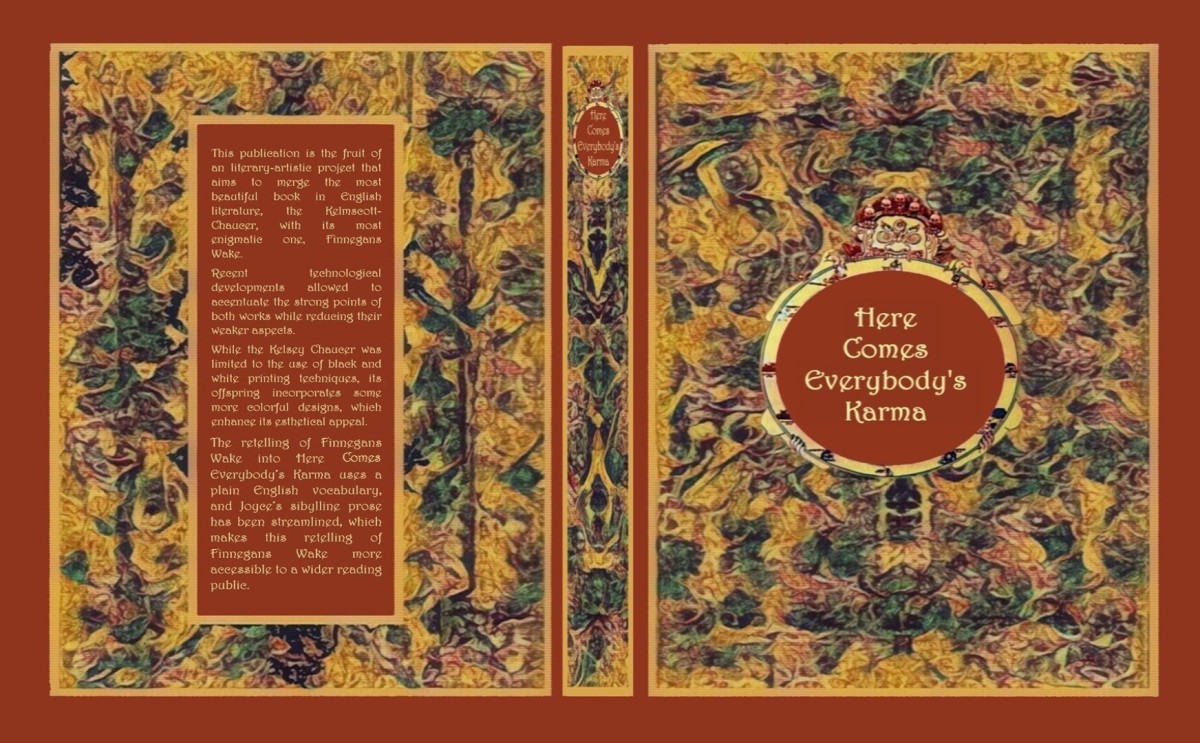
Here Comes Everybody’s Karma

The launch of this novel took place during the Bloomsday Festival in Dublin on June 11th between 6 – 8 pm at The Hole In The Wall Pub, 527 Blackhorse Avenue, Dublin, County Dublin, D07 NTP1, Ireland.

This publication is the result of a literary-artistical experiment aiming at merging the most beautiful publication in English literature with its most enigmatic one.
The result of this endeavor has been condensed in this retelling of Finnegans Wake as Here Comes Everybody’s Karma.
It is widely agreed upon that the Kelmscott-Chaucer is the most beautiful book ever printed and that Joyce’s Finnegans Wake is the most ingenious one (or vilified one: depending upon one’s personal opinion for what is appropriate English literature).
Weirdly enough, both publications seem to suffer from a rather uncommon literary defect that has been defined as: their readability!
The Kelmscott Chaucer used Walter William Skeat’s edition of the complete Chaucer, after explaining to the delegates of the Clarendon Press that his edition was intended to be an “art object” and would not compete with their six-volume edition of Skeat’s edition of Chaucer’s complete works. It contains 87 wood engravings of drawings by Edward Burne-Jones. Peter Faulkner, a William Morris expert, expressed his preference for The Canterbury Tales by the Golden Cockerel Press, noting that in the Kelmscott Chaucer, “the two sixty-three-line columns of 12-point type on the large page do not make for easy reading.”
Joyce claimed that by writing Finnegans Wake he was attempting to “reconstruct the nocturnal life”, and that the book was his “experiment in interpreting ‘the dark night of the soul’.” Alas, for most lovers of English literature, he (subconsciously?) created a reader’s ultimate nightmare.
The impression exists that only accomplished philologists have ever managed to decipher the novel’s polysemantic vocabulary that was borrowed from approximately sixty-five languages and dialects.
This retelling is an effort to remediate those issues while enhancing their inherent qualities.
Evolutions in modern printing techniques have allowed to elevate this offspring of the Kelmscott-Chaucer from its black and white corset while avoiding the typographic setting that made for a difficult reading experience.

The foreign language idiosyncrasies in Finnegans Wake have been replaced by their English equivalent and Joyce’s sibylline prose has been streamlined into a more fluid syntaxis.
Albeit there exists a generally accepted scholarly interpretation of Finnegans Wake, Joyce’s stream-of -consciousness writing style causes that many readers walk away with their own interpretation of the novel. This is also valid for the retelling of Finnegan’s Wake into Here Comes Everybody’s Karma.
Where Joyce proclaimed that the novel’s cyclical nature is best demonstrated by the feature that it begins and ends in the middle of a sentence, this retelling expresses the cyclical nature of the tale by beginning and ending in connecting circumstances.
Also, the colors of the decorative frames of each chapter are evolving in consecutive shades as they appear on the color wheel, with the color of the frames of this introduction featuring the frame-colors of the last chapter of this novel, while having a slightly different design.

Reviewers and other interested parties can now download an ARC of this book on NetGalley by using this link

B,C & D Publishers Launches: A Pan-Historical Fantasy for a New Era


Date: October 24, 2025
Locations: Frankfurt Book Fair (Digital Pavilion) & Barcelona (Live Presentation)

Barcelona, Spain – The Maharajagar, a sweeping five-volume historical fantasy epic, will be unveiled in a groundbreaking dual launch event this October: digitally at the prestigious Frankfurt Book Fair and live in Barcelona.

Written in English and weaving global mythologies, speculative metaphysics, and historical realities into a breathtaking tapestry, The Maharajagar reimagines the 20th century as a stage for karmic war, ancestral reckoning, and multidimensional memory.

From Harlem to Carcosa, from Alakapuri to Hiroshima, this saga spans continents and dimensions as the enigmatic Qi’tet battles not merely evil—but entropy itself. It is a series for readers of The Mahabharata, Sandman, The Invisibles, or Cloud Atlas.

The Barcelona event will include a live ritual reading, panel discussion, and unveiling of the book’s striking cover art, followed by a Q&A with the author.

Join the resistance against forgetting. Enter the Maharajagar. For interviews, press access, or review copies, contact:
Fred Holland Day
Book Website: http://www.maharajagar.com